3D-Printed Metamaterials That Think While They Transform
Summary: MIT researchers have introduced "Bifur-circuits," a modular 3D-printed metamaterial framework that combines mechanical movement with integrated electronics. These structures can be reconfigured into multiple functional shapes while internally tracking their own geometric state without needing external wires, hinges, or motors.
Key Takeaways
- Self-Sensing Capability: Conductive pathways printed directly into metamaterial building blocks complete distinct electrical circuits for each shape configuration, allowing structures to detect their own shape.
- Mechanical Bifurcation: By taking advantage of sudden physical snapping mechanisms when force is applied, interconnected modules unlock an exponentially wide range of stable structural arrangements.
- End-to-End Workflow: The system leverages single-pass multi-material 3D printing and a custom Fusion 360 design tool to easily generate both the mechanical parts and accompanying code for interactive applications.
Detailed Overview
Traditional objects are typically designed for a single form and function. Adding shape-shifting capabilities normally requires mechanical complexity: hinges, motors, external cabling, and separate sensor networks.
Researchers at MIT's Computer Science and Artificial Intelligence Laboratory (CSAIL) have developed an alternative approach called Bifur-circuits. This system uses 3D-printed mechanical metamaterials that integrate both mechanical movement and dynamic electrical conductivity into identical modular blocks.

Each piece snaps together seamlessly, allowing final assemblies to be stretched, compressed, twisted, or reconfigured into vastly different geometries. Because the electrical connections are embedded directly inside the 3D-printed substrate, the object automatically detects its precise configuration without requiring exterior sensor wiring between individual units.
Real-World Demonstrations
To show the practical capabilities of Bifur-circuits, the researchers built several functional prototypes:
- Reconfigurable Furniture: A dynamic assembly that transforms from a chair into a tea table, or flattens completely for storage. The structure senses its state during transformation and sends updating geometry data to an attached digital display.
- Interactive Game Controller: A foldable input device that detects its physical shape and automatically launches different video games depending on how the controller is folded.
Deep Dive & Technical Insights
From Auxetics to Mechanical Bifurcation
Bifur-circuits expand on prior research into auxetic metamaterials—structures engineered with specific geometries that behave counterintuitively, such as expanding wider when stretched. While earlier smart metamaterials were limited to switching between two or three predetermined states, Bifur-circuits leverage mechanical bifurcation.
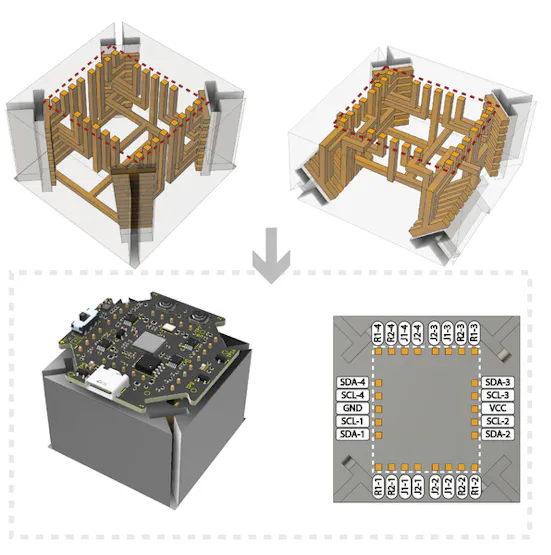
When external physical force crosses a designated threshold, connected metamaterial modules "snap" into new, stable configurations. Adding additional modules creates an exponentially larger state space, enabling simple modular assemblies to support complex multi-state structural transitions.
Embedded Conductive Pathways & Durability
Achieving self-sensing capabilities required integrating conductive filament directly into the structural non-conductive framework during printing:
- Dynamic Circuit Completion: Conductive material inside the blocks and connector units forms continuous electrical circuits that change depending on how the pieces are twisted or collapsed.
- State Recognition: Unique electrical pathways correspond to specific physical states, enabling connected hardware to determine both the state of individual modules and the macro-geometry of the entire assembly.
- High Durability: The conductive elements are flexible enough to undergo repeated mechanical stress. Testing confirmed that the printed structures retained reliable electrical connectivity even after enduring more than 10,000 compression cycles.
Integrated Design Workflow
To make constructing Bifur-circuits straightforward, the research team designed an end-to-end design pipeline:
- CAD Integration: A custom tool built for Autodesk Fusion 360 allows designers to assemble module layouts digitally.
- Single-Pass Multi-Material Printing: The physical blocks are fabricated in a single print job using dual conductive and non-conductive filaments, minimizing post-processing and manual assembly.
- Companion Software: Companion software automatically reads the completed physical structure's circuit layout and generates interactive code to trigger custom application behaviors based on shape changes.
Conclusion & Resources
By merging physical metamaterial mechanics with conductive pathways, MIT's Bifur-circuits demonstrate that passive geometry can replace complex external robotics and wire looms. Looking forward, metamaterials with built-in electronic intelligence could lead to self-contained interactive devices, smart furniture, and adaptable structural components that natively understand their physical form.
Further Reading
- Learn more about the underlying paper and system on the MIT Bifur-circuits Research Page.