Can AI Now Design PCBs That Just Work?
Summary: OpenAI's GPT-6 Astra model claims to design complete, fully routed circuit boards in KiCad directly from schematics. Testing by EEBench reveals that while AI offers promising shortcuts for quick prototypes, hardware engineering still requires human rigor to handle complex edge cases and production validation.
Key Takeaways
- OpenAI's KiCad Claims: The GPT-6 Astra model aims to take schematic inputs and generate complete, ready-to-manufacture routed PCBs in KiCad.
- EEBench Performance: GPT-6 Astra achieved a 69.3% benchmark score on hardware design tasks, performing similarly to Claude Opus 5 while offering faster and cheaper operation.
- Human Oversight Required: While AI "vibe-coding" simplifies rapid prototyping, full production boards still demand rigorous human validation, edge-case analysis, and stringent testing.
Detailed Overview
With the release of its GPT-6 Astra model, OpenAI made the explicit claim that artificial intelligence is now capable of designing complete circuit boards in KiCad. Starting from a provided schematic, the model outputs a fully routed PCB that theoretically could be sent off to be manufactured.
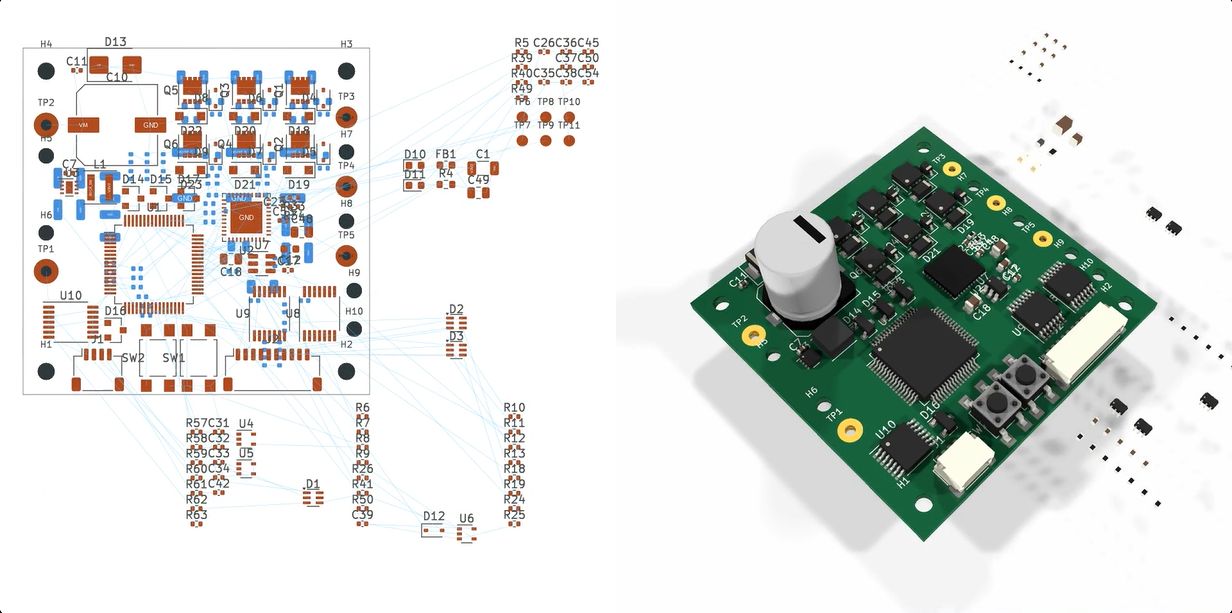
This claim naturally raises the question: is AI-driven layout simply a party trick suited only for strictly controlled conditions, or is there more to it? A recent evaluation in an EEBench blog post put OpenAI's claims to the test.
Evolution from Earlier LLMs
Back in 2024, evaluations of how Large Language Models (LLMs) handle circuit board design concluded that manual layout remained far more practical. However, tracking progress in this space has become easier thanks to targeted benchmarks.
EEBench operates as an electrical engineering agent benchmark designed to test how effective AI agents are at performing useful hardware engineering work. Under their methodology, taking a schematic and producing a populated, routed PCB is recognized as just one step among many in the hardware design process.
Deep Dive & Technical Insights
According to the benchmark results, GPT-6 Astra scores 69.3% (+/- 10%) on EEBench's hardware evaluation suite. This score places its performance roughly in the same ballpark as Claude Opus 5, albeit operating faster and at a lower cost.
It is worth noting that EEBench is maintained by the developers behind Atopile, a code-based system designed for creating PCBs in KiCad with a strong emphasis on integration with AI agents.
Despite these performance gains, the findings emphasize that hardware engineers are far from obsolete:
- Prototyping Shortcuts: "Vibe-coding" a quick prototype PCB can serve as a helpful shortcut for hobbyists or preliminary testing.
- Edge Case Rigor: Production PCBs must handle complex edge cases, power delivery nuances, and signal integrity that LLMs can easily overlook.
- Validation and Testing: High-stakes physical hardware requires validation by multiple independent engineers and rigorous testing prior to committing to full manufacturing runs.
Conclusion & Resources
AI models like GPT-6 Astra demonstrate real progress in automating basic PCB routing and layout in KiCad. However, while they provide useful shortcuts for early prototypes, full production hardware still relies on human expertise to guarantee reliability, safety, and compliance.