Introducing WeatherNext 3: Our Most Advanced Global Weather AI Model
Summary: Google DeepMind and Google Research have introduced WeatherNext 3, a global weather AI model that generates hourly forecasts at high spatial resolution. By leveraging live geostationary satellite data and weather station observations, it provides highly accurate, localized weather predictions integrated across Google Search, Gemini, Maps, and Google Cloud.
Key Takeaways
- Hourly, High-Resolution Forecasts: Delivers global forecasts every hour at up to 5-kilometer spatial resolution—roughly five times sharper than WeatherNext 2.
- Real-Time Data Ingestion: Replaces physics simulation lags by learning directly from live geostationary satellite observations and sparse station data.
- Breakthrough Precipitation Accuracy: Achieves up to a 60% CRPS improvement in precipitation forecasting using NASA IMERG and satellite radar reanalysis.
- Clean Energy Variables: Introduces predictions for 100-meter wind speeds, cloud cover, and solar radiation to aid renewable energy operators.
Detailed Overview
Every day, weather influences billions of decisions—from grabbing an umbrella to managing agriculture, supply chains, clean energy production, and disaster response. While AI has transformed forecasting by analyzing historical records, predicting rapidly changing, local weather events has remained difficult due to low spatial resolution and data lags in traditional models.
Google DeepMind and Google Research have launched WeatherNext 3, an advanced global weather model. By learning directly from real-time observations, WeatherNext 3 delivers timely, localized predictions across Google products worldwide.
Rapid Weather Prediction at Unprecedented Resolution
Forecast utility relies on fine spatial and temporal detail. WeatherNext 3 produces hourly forecasts across multiple resolutions while preserving physical consistency from global wind patterns to local terrain:
- 5-kilometer resolution: Key surface variables (temperature and moisture).
- 10-kilometer resolution: Other surface variables.
- 25-kilometer resolution: Atmospheric variables (e.g., wind speed).
Overall, this yields a global view roughly five times sharper than WeatherNext 2, which operated on a 25-kilometer grid in 6-hour increments.
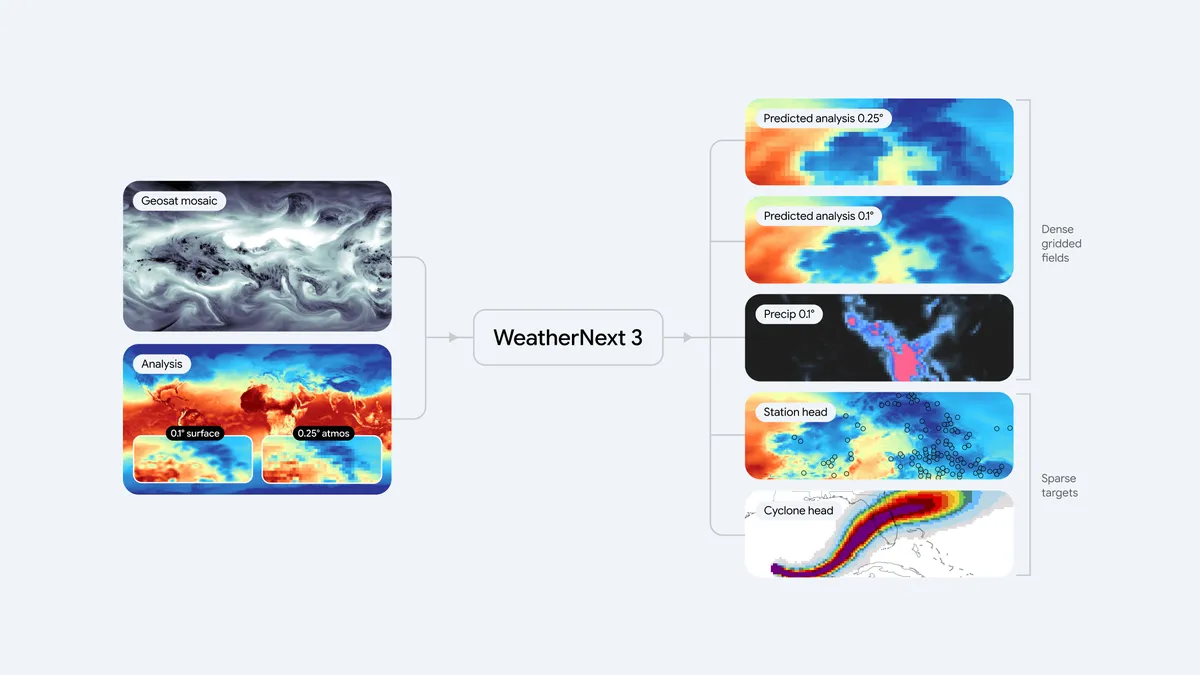 Figure 1: The end-to-end WeatherNext 3 system architecture. The model ingests live 1-hour geostationary satellite mosaics alongside traditional historical analysis to feed a single, flexible Functional Generative Network (FGN) mesh transformer.
Deep Dive & Technical Insights
Real-World Data at Continuous Global Scale
Traditional numerical weather prediction (NWP) models rely on supercomputer physics simulations that carry a six-hour data lag, introducing potential biases for rapid weather shifts. WeatherNext 3 addresses this with two core innovations:
- Live Geostationary Satellite Mosaics: Continuously feeds live global satellite data into the model, generating fresh forecasts every hour grounded in recent atmospheric conditions.
- Sparse Weather Station Training: Trains directly on ground-level station observation data rather than low-resolution atmospheric representations, capturing micro-climates created by coastlines, valleys, and mountain ranges.
This capability brings high-fidelity, localized forecasting to historically underserved regions across Latin America, Africa, and Asia-Pacific without requiring massive regional supercomputing infrastructure.
Traditional NWP Models: Physics Simulation (6-Hour Data Lag) ➔ Low Spatial Detail
WeatherNext 3: Live Satellite Mosaics + Station Data ➔ Hourly Updates (Up to 5 km Grid)
Specialized Variables for Clean Energy
To support grid operators and renewable developers, WeatherNext 3 includes dedicated clean energy forecasting variables:
- 100-Meter Wind Speeds: Estimates power potential at wind turbine height.
- Solar Radiation & Cloud Cover: Helps solar farms predict ground-level light availability to balance energy supply with demand.
Breakthrough Precipitation Accuracy
Rain and snow systems involve rapid, small-scale cloud processes that traditional physics models struggle to capture, often leading to blurry forecasts. WeatherNext 3 trains on two high-quality datasets:
- NASA’s Integrated Multi-satellite Retrievals for GPM (IMERG)
- Satellite radar-based global precipitation reanalysis
In medium-range global forecast evaluations, WeatherNext 3 achieved Continuous Ranked Probability Score (CRPS) improvements of up to 60% against IMERG, 30% against MRMS, and 10% against rain gauge measurements for early lead times.
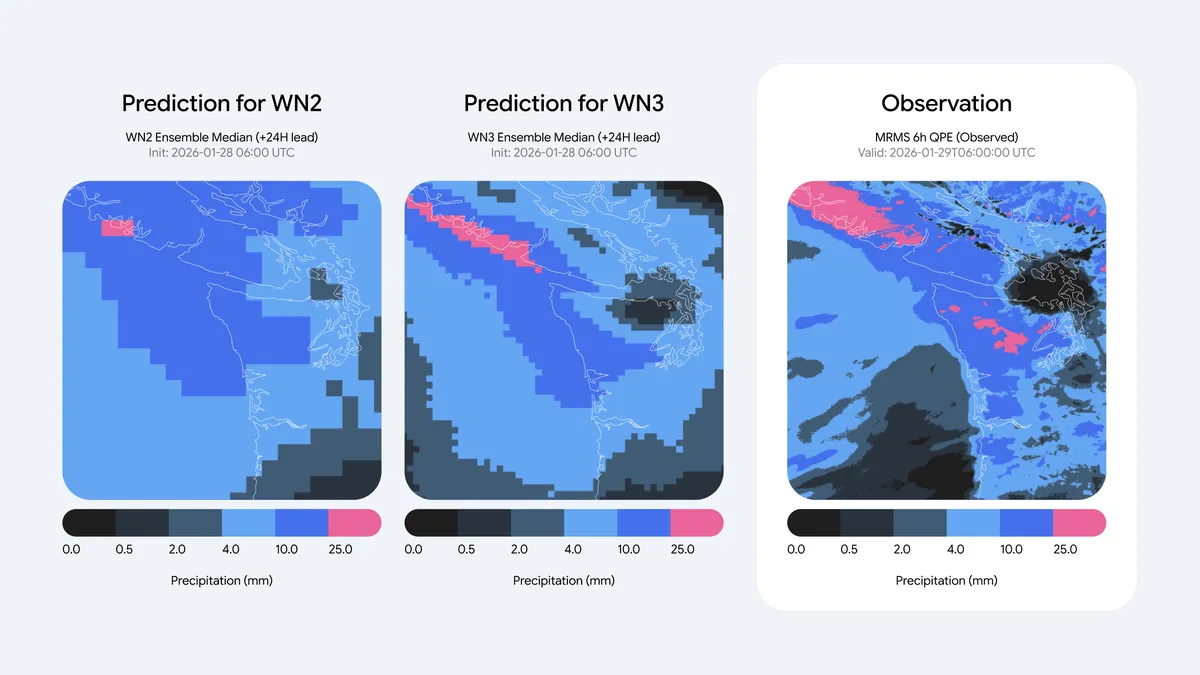 Figure 3: Medium-range probability of precipitation forecast comparison. WeatherNext 2 (left) at 25-kilometer resolution vs. WeatherNext 3 (middle) at 11-kilometer resolution, which closely mirrors actual satellite ground truth (right).
Ecosystem Integration
WeatherNext 3 is integrated across Google's suite of products and developer platforms:
- Google Ecosystem: Powers weather insights in Google Search, Gemini, Google Maps, Google Maps Platform Weather API, and Google Earth Engine. Users planning ahead will see up to 50% more accurate precipitation forecasts.
- Developer & Enterprise Access: Researchers and businesses can query high-resolution forecast datasets in Google BigQuery and Earth Engine, or download data in bulk via Google Cloud Storage.
Conclusion & Resources
WeatherNext 3 represents a major step forward in global weather intelligence, moving from delayed physics simulations to real-time observation training on a high-resolution grid.
Disclaimer: For official weather forecasts, severe weather warnings, and public safety advisories, please refer to your local meteorological agency or national weather service.
Further Reading & Developer Links
- Research Paper: Read the WeatherNext 3 Paper on arXiv
- Developer Documentation: Build with WeatherNext 3 on Google Developers
- Interactive Visualizations: Explore Weather Lab
- Live Leaderboard: Check Brightband Independent Live Leaderboards
- Geospatial Tools: Explore Google Earth Engine and AlphaEarth Foundations