Guide to 3D Printing Materials: Types, Applications, and Properties
Summary: This comprehensive guide outlines the primary plastic and metal 3D printing materials, comparing their mechanical properties, applications, and processes. It provides a structured three-step framework to help engineers and designers select the ideal material for prototyping, tooling, and end-use manufacturing.
Key Takeaways
- Process & Material Alignment: Choosing the right material depends heavily on the printing technology (FDM, SLA, or SLS) and whether the application requires thermoplastics or thermosets.
- Isotropy vs. Anisotropy: SLA and SLS parts offer isotropic strength across print layers, making them ideal for load-bearing and detailed functional components, whereas FDM parts are anisotropic due to layer line voids.
- Structured Selection Strategy: Evaluating parts based on a three-step framework—defining performance requirements, translating them to material properties, and selecting the final process—ensures reliable performance and cost-efficiency.
Detailed Overview
3D printing empowers you to prototype and manufacture parts for a wide range of applications quickly and cost-effectively. But choosing the right 3D printing process is just one side of the coin. Ultimately, it'll be largely up to the materials to enable you to create parts with the desired mechanical properties, functional characteristics, or looks.


Types of Plastic Materials
There are two main types of plastics used in 3D printing:
- Thermoplastics: Thermoplastics are the most commonly used type of plastic. The main feature that sets them apart from thermosets is their ability to go through numerous melt and solidification cycles. Thermoplastics can be heated and formed into the desired shape. The process is reversible, as no chemical bonding takes place, making recycling or melting and reusing thermoplastics feasible. A common analogy for thermoplastics is butter, which can be melted, re-solidified, and melted again.
- Thermosetting plastics: Thermosetting plastics (thermosets) remain in a permanent solid state after curing. Polymers in thermosetting materials cross-link during a curing process induced by heat, light, or suitable radiation. Thermosetting plastics decompose when heated rather than melting, and will not reform upon cooling. A thermosetting material is like cake batter: once baked into a cake, it cannot be melted back into batter.

Plastic 3D Printing Processes
The three most established plastic 3D printing processes today are:
- Fused Deposition Modeling (FDM): Melts and extrudes thermoplastic filaments, which a printer nozzle deposits layer by layer in the build area.
- Stereolithography (SLA): Uses a laser to cure thermosetting liquid resins into hardened plastic through photopolymerization.
- Selective Laser Sintering (SLS): Uses a high-powered laser to fuse small particles of thermoplastic powder.

Breakdown of Printing Technologies & Materials
FDM 3D Printing
Fused deposition modeling (FDM), also known as fused filament fabrication (FFF), is widely used for basic proof-of-concept models and low-cost prototyping of simple parts.
Consumer-level FDM has lower resolution and accuracy compared to SLA or SLS. As melted filament forms each layer, voids can remain between layers, resulting in anisotropic parts.

Popular FDM Materials
| Material | Features | Applications |
|---|---|---|
| ABS (acrylonitrile butadiene styrene) | Tough and durable; Heat and impact resistant; Requires heated bed and ventilation | Functional prototypes |
| PLA (polylactic acid) | Easiest FDM material to print; Rigid, strong, but brittle; Less heat/chemical resistant; Biodegradable | Concept models; Looks-like prototypes |
| PETG (polyethylene terephthalate glycol) | Compatible with lower print temperatures; Humidity and chemical resistant; High transparency | Waterproof applications; Snap-fit components |
| Nylon | Strong, durable, lightweight; Tough and partially flexible; Heat and impact resistant | Functional prototypes; Wear resistant parts |
| TPU (thermoplastic polyurethane) | Flexible and stretchable; Impact resistant; Vibration dampening | Flexible prototypes |
| PVA (polyvinyl alcohol) | Soluble support material; Dissolves in water | Support material |
| HIPS (high impact polystyrene) | Soluble support material used with ABS; Dissolves in limonene | Support material |
| Composites (carbon fiber, Kevlar, fiberglass) | Rigid, strong, or extremely tough; Requires compatible industrial printers | Functional prototypes; Jigs, fixtures, and tooling |
SLA 3D Printing
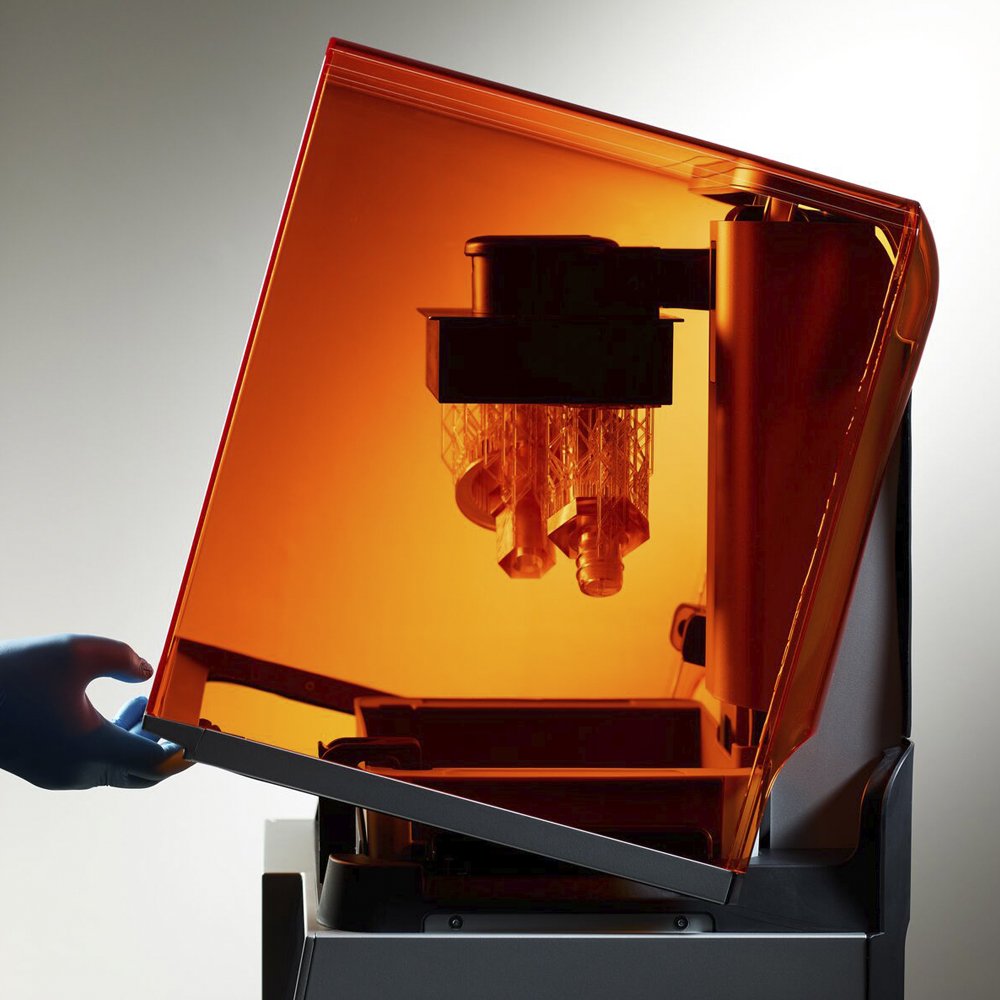
Stereolithography (SLA) produces parts with high resolution, tight tolerances, clear details, and smooth surface finishes. Parts printed using SLA are isotropic, meaning their strength is consistent across all orientations due to chemical bonding between layers.

Popular SLA Materials
| Formlabs Materials | Features | Applications |
|---|---|---|
| General Purpose Resins | High resolution; Smooth, matte surface finish | Concept models; Looks-like prototypes |
| Clear Resin | Highly transparent; Polishes to near optical transparency | Transparent parts; Millifluidics |
| Fast Model Resin | 2-3x faster than standard resins, up to 10x faster than FDM | Initial prototypes; Rapid iterations |
| Color Resin | Custom colors; Bright, colorful parts | CMF prototypes; Color-coded jigs |
| Tough Resins | Handles compression, stretching, and impact; Similar to HDPE, ABS, or PP | Housings; Jigs and fixtures; Connectors |
| Rigid Resins | Highly filled, strong, stiff; Thermally and chemically resistant | Tooling; Turbines; Electrical casings |
| Clear Cast Resin | Clean burnout; Low thermal expansion; Highly accurate | Investment casting patterns for metal parts |
| Polyurethane Resins | UV, temperature, and humidity stable; Long-term durability | Automotive, aerospace, and machinery parts |
| High Temp Resin | High thermal resistance and precision | Gas/fluid flow; Heat resistant mounts |
| Flexible Resins | Simulates rubber, TPU, or silicone; Withstands repeated flex cycles | Consumer goods; Robotics; Medical models |
| Silicone 40 A Resin | 100% silicone material; Superior cast silicone properties | Functional silicone prototypes; Soft molds |
| Medical and Dental Resins | Biocompatible resins for medical and dental applications | Surgical guides; Dentures; Prosthetics |
| Jewelry Resins | Burnout resins for investment casting | Custom jewelry; Reusable mold masters |
| ESD Resin | Electrostatic discharge safe material | Anti-static electronics manufacturing tooling |
| Flame Retardant (FR) Resin | Flame retardant, heat/creep resistant | Aircraft/automotive interiors; Electronics |
| Alumina 4N Resin | 99.99% pure alumina ceramic; High thermal/electrical insulation | Chemical and wear-resistant tools |

SLS 3D Printing
Selective laser sintering (SLS) uses a laser to sinter powder particles. Because unfused powder supports the model during printing, dedicated support structures are not required. This allows for complex geometries, internal channels, and interlocking parts.


Popular SLS Materials
| Material | Description | Applications |
|---|---|---|
| Nylon 12 | Strong, stiff, sturdy, and durable; Resistant to UV, heat, moisture, and solvents | Functional prototyping; End-use parts; Medical devices |
| Nylon 11 | Higher elasticity, elongation at break, and impact resistance than Nylon 12 | Impact-resistant prototypes and end-use parts |
| Nylon Composites | Reinforced with glass, aluminum, or carbon fiber for higher strength | Structural end-use parts; Rigid prototypes |
| TPU | Flexible, elastic, rubbery material; Great shock absorption and UV stability | Wearable items; Rubber-like functional parts |

Deep Dive & Technical Insights
Technology Comparison Matrix
| Feature / Metric | FDM | SLA | SLS |
|---|---|---|---|
| Pros | Low-cost entry options; Wide availability of standard materials | High accuracy; Smooth surface finish; Wide functional resin variety | Strong functional parts; High design freedom; No support structures |
| Cons | Lower accuracy; Visible layer lines; Anisotropic strength | Sensitive to long-term UV exposure | Higher hardware cost; Limited material choices |
| Primary Applications | Concept models; Basic rapid prototyping | Detailed prototypes; Molds; Dental & Medical; Jewelry casting | Functional prototypes; Low-volume production; End-use parts |
| Materials | Thermoplastics (ABS, PLA, PETG, TPU, Composites) | Thermosetting photopolymers (Standard, Tough, Rigid, Flexible, Biocompatible, Ceramic) | Engineering thermoplastics (Nylon 11, Nylon 12, Composites, TPU, PP) |

Metal 3D Printing & Alternatives
Metal 3D printing enables high-strength structural parts directly from digital CAD files. Common methods include:
- Metal FDM: Extrudes bound metal rods; parts require binder removal and sintering in a furnace.
- SLM / DMLS: Uses a laser to selectively melt or sinter fine metal powders layer by layer.
Common Metal Materials
- Titanium: Lightweight, strong, highly resistant to heat and corrosion.
- Stainless Steel: High ductility, high strength, and corrosion resistance.
- Aluminum: Good thermal properties, high strength-to-weight ratio.
- Tool Steel: Hard and scratch-resistant for manufacturing tools.
- Nickel Alloys: High tensile and creep strength under high temperatures.
Alternatives to Direct Metal Printing
Direct metal 3D printing systems carry significant capital equipment costs. Common alternatives include:
- Investment Casting: Printing sacrificial SLA patterns in wax/castable resin to cast metal.
- Electroplating: Depositing a thin metal layer onto a 3D-printed plastic substrate via electrolysis to add electrical conductivity and wear resistance.

Framework for Choosing the Right Material
Step 1: Define Performance Requirements
| Performance Level | Description | Recommended Options |
|---|---|---|
| Low Performance | Basic form and fit testing, visual prototypes. Low structural load. | FDM: PLA SLA: General Purpose, Clear, Fast Model, Color |
| Moderate Performance | Functional testing, snap fits, enclosures under moderate impact/load. | FDM: ABS SLA: Tough & Durable Resins SLS: Nylon 11, Nylon 12, TPU |
| High Performance | End-use components under constant wear, severe stress, or thermal variation. | FDM: Composites SLA: Polyurethane, High Temp, FR, Biocompatible SLS: Nylon Composites, TPU |
Step 2: Translate Performance Requirements to Specific Properties
| Property | Definition | Top Material Recommendations |
|---|---|---|
| Tensile Strength | Resistance to breaking under tension load. | SLA Rigid / Alumina 4N, SLS Nylon 12, FDM PLA |
| Flexural Modulus | Modulus indicating rigidity vs. flexibility under bending. | SLA Rigid (High), SLA Tough (Med), SLA Flexible (Low) |
| Elongation | Percentage stretch before breaking. | FDM/SLS TPU, SLA Flexible, SLA Silicone 40 A |
| Impact Strength | Shock absorption capability without fracturing. | SLA Tough 2000 / 1500, FDM ABS/Nylon, SLS Nylon 11 |
| Heat Deflection Temp (HDT) | Deformation threshold under specified thermal load. | SLA High Temp, SLA Alumina 4N, SLS Nylon 12 |
| Durometer / Hardness | Surface resistance to indentation (rubbers/elastomers). | SLA Flexible/Silicone 40 A, FDM TPU, SLS TPU |
| Creep Resistance | Longevity under constant structural stress. | SLA Rigid, SLS Nylon 12, FDM ABS |
Step 3: Make Final Selection
Filter the prospective options based on required properties. Where multiple candidates qualify, evaluate trade-offs like surface finish, machine cost, post-processing effort, and print speeds to select the optimal workflow.
Conclusion & Resources
Choosing the ideal 3D printing material requires balancing functional requirements, mechanical demands, surface aesthetics, and financial constraints. By understanding the core distinctions between thermoplastics and thermosets—along with the structural behaviors of FDM, SLA, and SLS technologies—manufacturers can systematically match project specifications to the ideal material.
Additional Resources
- Explore material data sheets and technical properties via the Formlabs Materials Library.
- Review process differences in depth through the Formlabs SLA Guide and Formlabs SLS Guide.