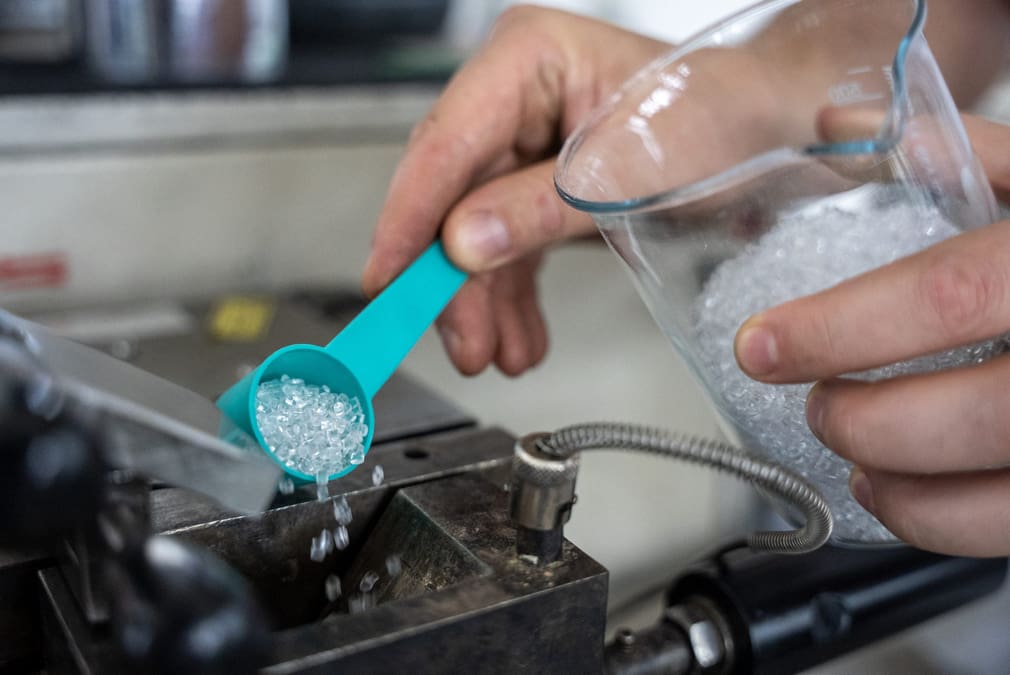
Prusa Research has introduced Prusament Pellets, making the raw polymer granules used in its popular filament lines directly available to consumers, makers, and industrial shops. Designed for large-format pellet extrusion, material research, and DIY filament making, the lineup delivers substantial cost savings without requiring industrial-scale procurement contracts.
A standard 1-kg spool of Prusament PLA retails at $29.99. In contrast, PLA pellets drop that figure to $11.25 per kilogram in a 4-kg package and down to $10.71 per kilogram when purchasing a 14-kg batch—slashing raw material expenditure by more than 60%.
Direct Extrusion and Material Breakdown
Prusament Pellets are packaged in uncolored, natural formulations across four primary thermoplastic polymers. Unlike bulk industrial granules that require purchasing entire metric tons, Prusa packages these pellets in smaller accessible volumes ranging from 3.5 kg to 14 kg.
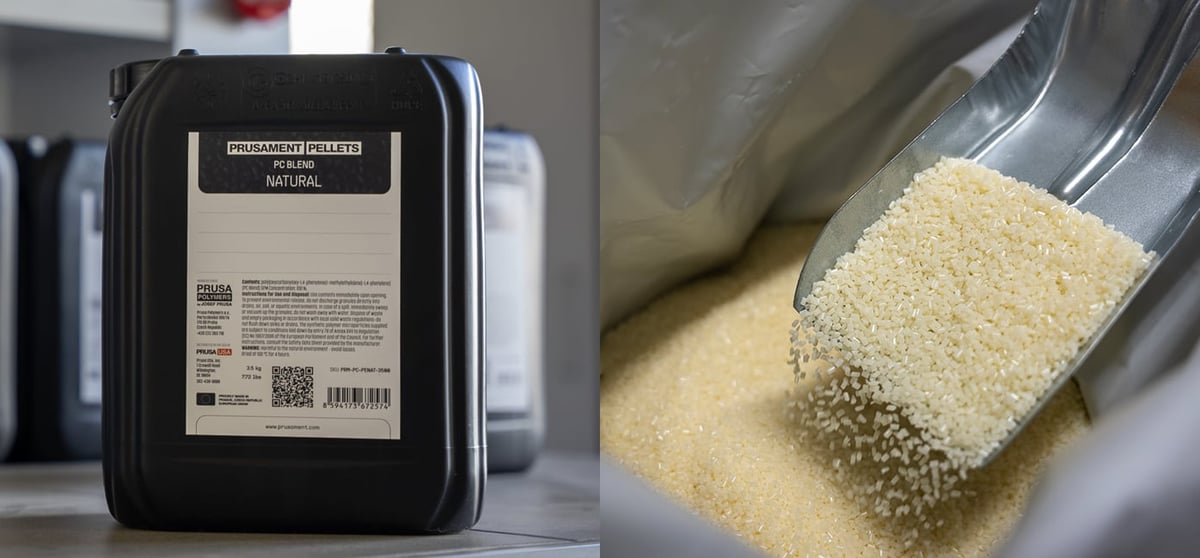
1. Prusament PLA Pellets
- Base Form: Uncolored natural polylactic acid granules.
- Pricing Tier: From $44.99 for 4 kg ($11.25/kg) to $10.71/kg for 14 kg.
- Primary Use Case: High-speed prototyping, large decorative items, architectural models, and general extrusion testing.
2. Prusament PETG Pellets
- Base Form: Uncolored natural polyethylene terephthalate glycol.
- Pricing Tier: Starting at $44.99 for 4 kg.
- Primary Use Case: Functional parts requiring chemical resistance, mechanical durability, and moderate temperature thresholds.
3. Prusament ASA Pellets
- Base Form: Uncolored natural acrylonitrile styrene acrylate.
- Primary Use Case: Outdoor enclosures, automotive exterior elements, and high-UV exposure applications.
4. Prusament PC Blend Pellets
- Base Form: Uncolored natural polycarbonate blend.
- Pricing Tier: Up to $199.99 for a 12-kg package.
- Primary Use Case: High thermal resistance, structural prototypes, and heavy-duty industrial components.
Pro-Tip: Prusament Pellets arrive pre-dried in sealed canisters or moisture-resistant bags straight from Prusa's manufacturing line. For direct pellet-fed printing, they are typically ready to feed straight from the package, saving hours of dehumidifying prep time.
Granule Extrusion vs. Filament Fabrication
Pellet-fed additive manufacturing diverges from traditional Fused Deposition Modeling (FDM) by melting raw plastic granules directly in a specialized screw extruder rather than feeding a drawn 1.75 mm or 2.85 mm strand.
- Direct Pellet 3D Printers: Machines such as the desktop-scale Piocreat G5 Ultra or the industrial-scale Re3D Gigabot X2 bypass filament spools entirely. By depositing multiple kilograms of molten plastic per hour, pellet systems significantly reduce production time for large items like furniture, fixtures, and molds.
- Custom In-House Filament Extrusion: Workshops with desktop filament extruders can use these base pellets to compound customized filaments by introducing masterbatch colorants, UV stabilizers, or reinforcement additives.
Material & Pricing Comparison
| Material Variant | Base Color | Available Pack Sizes | Starting Price | Price per Kilogram |
|---|---|---|---|---|
| Prusament PLA | Natural (Uncolored) | 4 kg / 14 kg | $44.99 (4 kg) | ~$10.71 – $11.25 / kg |
| Prusament PETG | Natural (Uncolored) | 4 kg / 14 kg | $44.99 (4 kg) | ~$10.71 – $11.25 / kg |
| Prusament ASA | Natural (Uncolored) | 3.5 kg – 12 kg batches | Variable by pack | Competitive pellet rates |
| Prusament PC Blend | Natural (Uncolored) | Up to 12 kg | $199.99 (12 kg) | ~$16.66 / kg |
| Finished Filament (Ref) | Spooled | 1 kg spool | $29.99 (1 kg) | $29.99 / kg |
Final Recommendation & Summary
The release of Prusament Pellets bridges a significant market gap between hobby-scale spools and massive industrial minimum-order quantities:
- For Large-Format Print Farms: If you operate direct pellet-fed extruders, purchasing raw granules yields an immediate cost reduction of up to 60%, removing spool management overhead.
- For R&D Labs & Universities: The smaller 3.5 kg to 14 kg package sizes provide a clean, pre-dried polymer baseline for polymer research, additive compounding, and mechanical testing without high capital expense.
- For DIY Filament Makers: Factor in operational costs—including extrusion hardware wear, electrical draw, and calibration scrap—to ensure your custom extrusion runs remain cost-effective against finished spools.
Join the Discussion
Are you using direct pellet extrusion in your shop, or are you planning to blend custom filaments using desktop extruders? Let us know what materials and equipment setups you run in the comments below!