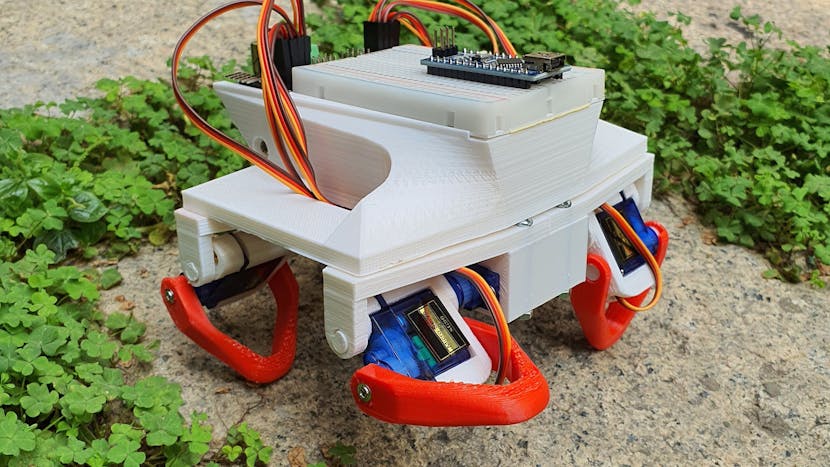
Robotics education often comes with a steep barrier to entry, requiring expensive proprietary kits or complex mechanical parts. Designer Nguyễn Phương Duy set out to change that by introducing Boca, an open-source, 3D-printed quadruped robot platform designed specifically for makers, students, and researchers interested in control theory, machine learning, and reinforcement learning.
By blending standard off-the-shelf microcontrollers and servo motors with readily available 3D printable files, Boca provides an approachable, tactile testbed for complex locomotion algorithms.
Locomotion and Kinematics Breakdown
At its core, Boca features an 8-degree-of-freedom (8-DOF) arrangement, giving it a flexible range of motion to navigate various surfaces. The robot already has completed inverse kinematics implementation, allowing it to maneuver dynamically using predefined gaits.

Beyond standard kinematic control, the roadmap for the platform includes integrating simulated environments and reinforcement learning models, as well as support for external peripheral add-ons. For advanced robotics experimentation, Duy is also developing a 12-DOF variant to support more sophisticated quadruped dynamics.
Watch the robot in action via the video demonstration below:
Watch Video Demonstration: Boca Quadruped Robot in Motion
Hardware Architecture & Open-Source Resources
Boca’s modular electronics ecosystem relies on accessible components that are simple to wire and program.

Key Hardware Specifications
- Core Controller: Arduino Nano
- Actuation: 8 × TowerPro SG90 micro servo motors
- Servo Driver: PCA9685 16-channel PWM servo driver module
- Connectivity: HC-05 Bluetooth module
- Power Supply: Two 18650 Li-ion batteries with an integrated holder and step-down converter
- Structural Frame: Fully 3D-printed chassis and leg linkages
Included Software & Simulation Resources
- PyBullet Simulation: Custom PyBullet simulation models and environments for reinforcement learning (RL) and RF testing.
- Processing Simulation: Motion simulation scripts developed in Processing to visualize kinematics.
- Open-Source CAD: Full CAD model files available for personal fabrication and mechanical modifications.
Pro-Tip: If you are exploring gait design and reinforcement learning, test your locomotion algorithms inside the provided PyBullet simulation environment first before flashing them to physical servos to avoid mechanical stress and motor stalling.
Configuration Matrix
Boca can be built completely from scratch or ordered as a ready-to-use platform:
| Option | Components Included | Assembly Required | Course Access | Target Audience |
|---|---|---|---|---|
| Fully Assembled | Complete robot, pre-calibrated servos, all wiring, and battery holder | None (Plug & Play) | No | Researchers focusing strictly on high-level algorithms |
| Maker Kit | Arduino Nano, 8 SG90 servos, PCA9685, HC-05, step-down module, 18650 holder, hardware | Yes | Yes | Students and hobbyists wanting guided learning |
| DIY Self-Sourced | Downloadable open-source STLs, PyBullet models, Processing scripts | Yes (Print & Solder) | Repository Only | Makers with existing 3D printers and spare components |
Summary & Recommendations
Nguyễn Phương Duy’s Boca platform demonstrates that exploring machine learning and inverse kinematics does not require multi-thousand-dollar research robots. With standard micro servos, an Arduino Nano, and 3D-printed joints, makers get a capable testbed for complex gait simulation and reinforcement learning.
- Choose the Kit if you want structured educational materials and hands-on assembly experience.
- Choose the Fully Assembled Version if your goal is rapid deployment for motion studies without spending time on fabrication.
- Go the Open-Source DIY Route if you already own a 3D printer and spare hardware components.
Join the Discussion
Have you experimented with quadruped locomotion or simulated gaits in PyBullet? Which microcontroller and servo combination do you prefer for building small-scale robotics? Share your thoughts below!