Title: Predictive Insights: Key Dynamics and Technologies Reshaping 3D Printing in 2026
Predictive Insights: Key Dynamics and Technologies Reshaping 3D Printing in 2026
Introduction
The landscape of additive manufacturing (AM), or 3D printing, has seen significant advancements in recent years. From rapid prototyping to mass production, the technology’s versatility and adaptability have made it a cornerstone in various industries, including automotive, aerospace, healthcare, and consumer goods. As we look ahead to 2026, the industry is poised for transformative changes, driven by global economic and geopolitical factors, technological advancements, and innovative applications.
Key Dynamics
Global Economic and Geopolitical Uncertainty
The current global landscape is marked by significant economic and geopolitical instability, which has profound implications for manufacturing strategies worldwide. The reliance on a few global supply chains has highlighted the need for diversification and resilience. Additive manufacturing stands out as a promising solution, enabling localized production, reduced dependency on distant suppliers, and enhanced supply chain agility. By fostering a more decentralized production model, AM can mitigate the risks associated with global disruptions such as pandemics and trade wars.
Technological Accessibility
The democratization of AM technologies is enhancing accessibility and opening up new opportunities. As costs continue to drop and user-friendly software solutions become more prevalent, the barriers to entry for 3D printing are lowering. This democratization is not only enhancing the accessibility of AM for established manufacturers but also opening up opportunities for smaller enterprises and individual inventors. Businesses can innovate and scale their production more efficiently, expanding into new sectors and consumer applications, making AM a more integral part of everyday life.
Technological Trends
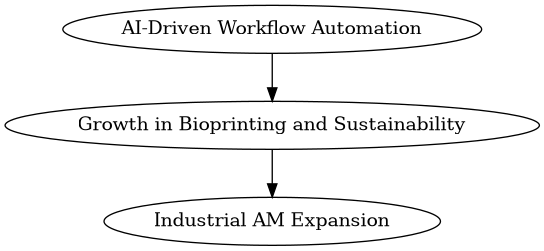
AI-Driven Workflow Automation
The integration of artificial intelligence (AI) into the workflow of AM is set to streamline operations, enhance design capabilities, and boost efficiency. AI algorithms can optimize print times, reduce material waste, and improve the accuracy of printed parts. Additionally, AI-driven design software can generate complex geometries and structures that are impossible to achieve with traditional manufacturing techniques, pushing the boundaries of AM. This automation not only lowers barriers to entry but also enables existing users to achieve higher levels of productivity and innovation.
Growth in Bioprinting and Sustainability
Advancements in bioprinting are opening up new frontiers in healthcare, with applications ranging from tissue engineering to organ transplantation. As the technology matures, bioprinting is expected to become a standard procedure in medical settings, addressing the growing need for personalized medical solutions. Moreover, the push for sustainability is driving the development of eco-friendly materials and production practices in AM, such as recycled filament, biodegradable resins, and closed-loop systems, reducing the environmental impact of 3D printing.
Industrial AM Expansion
Industrial AM is poised for significant growth, driven by the increasing demand for customized and high-performance parts. Market projections suggest substantial growth, with the value of the industrial AM market expected to reach billions of dollars by 2026. This expansion is accompanied by challenges like standardization, intellectual property protection, and the need for skilled labor. Despite these hurdles, the opportunities for growth and innovation in industrial AM are immense, and companies that can navigate these challenges effectively will reap the benefits.
Conclusion
By 2026, the 3D printing and AM landscape will have transformed significantly, driven by global economic and geopolitical shifts, technological advancements, and innovative applications. The democratization of AM technologies, the integration of AI, and the growth in bioprinting and sustainable practices are key dynamics shaping the industry’s future. As the market continues to expand, stakeholders must prepare for the opportunities and challenges ahead, positioning themselves for success in the next decade.
Additional Sections (Optional)
Case Studies
- Real-world examples of AM adoption and technological advancements.
- Detailed case studies illustrating successful implementations of AM in various industries.
Expert Opinions
- Insights from industry leaders and analysts.
- Perspectives on the future of 3D printing and AM.
Future Challenges
- Potential roadblocks and solutions for AM technology adoption.
- Discussion on regulatory, economic, and technological challenges.
Investment Opportunities
- Areas for financial stakeholders to consider.
- Analysis of promising investment sectors within the AM industry.
Meta Description: Explore the future of 3D printing and AM in 2026. Discover key dynamics and technological trends shaping the industry, including AI integration, bioprinting, and industrial growth.